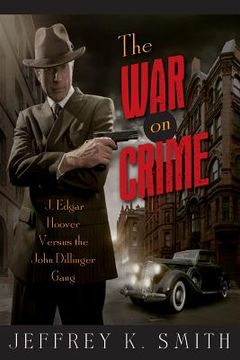
The War on Crime: J. Edgar Hoover Versus the John Dillinger Gang
Smith, Jeffrey K.
Synopsis "The War on Crime: J. Edgar Hoover Versus the John Dillinger Gang"
This is a story about cops and robbers, set against the backdrop of the Great Depression, a desperate time for many, when the boundaries between right and wrong were often blurred. It is the story of J. Edgar Hoover versus the John Dillinger Gang--the center pieces of the so-called War on Crime. It was an era of bank heists. Between 1931 and 1934, bank robberies in the United States averaged two per day. Three-quarters of those robberies occurred in the Midwest; in Indiana, alone, there were 29 bank robberies in 1933. The gangsters earned sympathy from many of their fellow countrymen. After the stock market crash of 1920, which precipitated the Great Depression, many jobless Americans saw their homes or farms drawn into foreclosure by banks. In the eyes of many small business owners and farmers, the banks were as much the enemy, if not more so, than the men who robbed them. Some who were deprived of their homes and livelihoods quietly cheered as the bank robbers extracted measure of revenge against the heartless financial powerbrokers. When John Dillinger began robbing banks in 1933, some 13,000,000 Americans were unemployed. Breadlines were commonplace throughout the country, while building entryways, park benches, and subway lobbies served as bedrooms for the homeless. Widespread despair reinforced the notion that banks had declared war against the common man. John Dillinger was the most celebrated off all the Depression-era bank robbers. A handsome and charismatic ladies' man, Gentleman John was also nicknamed the Jackrabbit--reflective of his agility when vaulting over bank counters. Unlike some of his bloodthirsty counterparts, Dillinger was known to have killed only one person during his crime spree, making him appear more roguish than dangerous. An elusive Dillinger became the Robin Hood of his generation. In the eyes of J. Edgar Hoover, John Dillinger was anything but a Robin Hood-like hero. Humorless, tightly wound, and self-righteous, Hoover viewed any measure of lawlessness as a threat to his organized world. Dillinger became America's first Public Enemy Number One. When Bureau agents finally ambushed and killed John Dillinger, Hoover's mastery of public relations helped birth the now-legendary Federal Bureau of Investigation (FBI). For the remaining 37 years of his life, J. Edgar Hoover wielded unprecedented power and influence from the throne he grandiosely, but aptly referred to as the Seat of Government. When Hoover's agents finally ambushed and killed Dillinger