Tracked shipping to Austria with premium packaging for just 3,99 € 

Ship to
Austria
0
  • argentina
  • chile
  • colombia
  • españa
  • méxico
  • perú
  • estados unidos
  • internacional

Select your country

Americas

Europe

Rest of the world

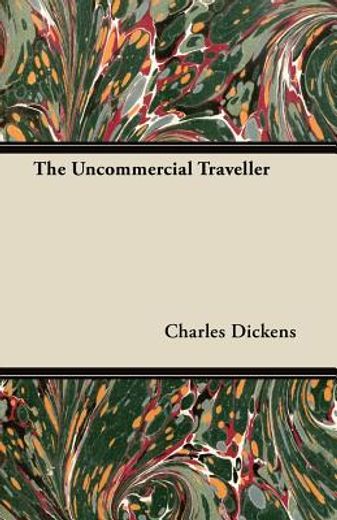
portada the uncommercial traveller
the uncommercial travellerthe uncommercial traveller
Type
Physical Book
Language
English
Pages
448
Format
Paperback
Dimensions
21.6 x 14.0 x 2.4 cm
Weight
0.53 kg.
ISBN
1443701491
ISBN13
9781443701495

the uncommercial traveller

G. K. Chesterton (Author) · Charles Dickens (Author) · Read & Co. Books · Paperback

the uncommercial traveller - Charles Dickens

New Book Imported to Austria
Delivery: 06 Aug - 10 Aug Shipping: 5 to 6 business days.
28,54 €
Import costs and 10% VAT included in the price ✅
28,54 €

Synopsis "the uncommercial traveller"

First published between 1860-1861, "The Uncommercial Traveller" is a collection of literary sketches and reminiscences written by Charles Dickens. They represent his main contributions to the journal "All the Year Round", which Dickens founded in 1859. Contents include: "His General Line Of Business", "The Shipwreck", "Wapping Workhouse", "Two Views Of A Cheap Theatre", "Poor Mercantile Jack", "Refreshments For Travellers", "Travelling Abroad", "The Great Tasmania's Cargo", "City Of London Churches", "Shy Neighbourhoods", etc. Charles John Huffam Dickens (1812-1870) was an English writer and social critic famous for having created some of the world's most well-known fictional characters. His works became unprecedentedly popular during his life, and today he is commonly regarded as the greatest Victorian-era novelist. Although perhaps better known for such works as "Great Expectations" or "A Christmas Carol", Dickens first gained success with the 1836 serial publication of "The Pickwick Papers", which turned him almost overnight into an international literary celebrity thanks to his humour, satire, and astute observations concerning society and character. This classic work is being republished now in a new edition complete with a specially-commissioned new biography of the author.
G. K. Chesterton
  (Author)
View Author's Page
G. K. Chesterton (London, May 29, 1874 – Beaconsfield, June 14, 1936) was a prolific British writer, author of essays, novels, poetry, biographies, and Christian apologetics. His work is characterized by irony, paradoxical wit, and a critical view of modernity. He was a prominent convert to Catholicism and an influential figure in religious and literary thought of his time. He is also known for his brilliant argumentative style and his defense of common sense.

Among his most recognized works are The Man Who Was Thursday (1908), Orthodoxy (1908), The Innocence of Father Brown (1911), Heretics (1905), The Ball and the Cross (1909), and The Resurrection of Rome (1930). He cultivated the essay, the novel of ideas, detective stories, and social and religious criticism.
See more
See less
Charles Dickens
  (Author)
View Author's Page
Charles Dickens (February 7, 1812 - June 9, 1870) was born in Portsmouth and was the eldest son of a Royal Navy clerk. At twelve, his father's imprisonment for debt forced him to work in a blacking factory. His education was sporadic: he taught himself shorthand, worked as a clerk in a law office, and eventually became a parliamentary correspondent for the Morning Chronicle.

Coming from a humble family, "good old Charles" did not receive formal education until he was nine, and was heavily criticized by the critics of the time for being too self-taught. His life took an unexpected turn with his father's imprisonment for debts, moving his family to live with him in jail, allowed at that time by British laws. At the age of 12, he was already considered fit to start working in a dye factory. Although his family's situation had improved, his mother insisted he keep working there, inspiring him to write one of his masterpieces, David Copperfield.

His articles, later collected in Scenes from London Life by "Boz" (1836-1837), were very successful, and with the appearance in 1837 of The Posthumous Papers of the Pickwick Club, Dickens became a true publishing phenomenon. Novels such as Oliver Twist (1837-1839), Nicholas Nickleby (1838-1839), and Barnaby Rudge (1841) gained enormous popularity, as did some travel chronicles, such as Pictures from Italy (1846). With Dombey and Son (1846-1848) he began his mature period, of which good examples are David Copperfield (1849-1850), his first novel in the first person and his favorite, in which he developed some autobiographical episodes; Bleak House (1852-1853); Little Dorrit (1855-1857), A Tale of Two Cities (1859), Great Expectations (1860-1861), and Our Mutual Friend (1864-1865). He died at Gad's Hill, his country house in Higham, in the county of Kent.
See more
See less

Customers reviews

Frequently Asked Questions about the Book

All books in our catalog are Original.
The book is written in English.
The binding of this edition is Paperback.

Questions and Answers about the Book

Do you have a question about the book? Login to be able to add your own question.

Opinions about Bookdelivery

More customer reviews