Tracked shipping to Austria with premium packaging for just 3,99 € 

Ship to
Austria
0
  • argentina
  • chile
  • colombia
  • españa
  • méxico
  • perú
  • estados unidos
  • internacional

Select your country

Americas

Europe

Rest of the world

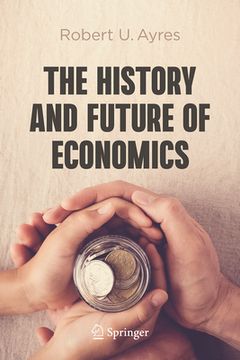
portada The History and Future of Economics
Type
Physical Book
Publisher
Language
English
Pages
402
Format
Hardcover
Dimensions
23.8 x 16.0 x 2.6 cm
Weight
0.84 kg.
ISBN13
9783031262074

The History and Future of Economics

Robert U. Ayres (Author) · Springer · Hardcover

The History and Future of Economics - Ayres, Robert U.

Cheaper New Book Imported to Austria
Delivery: 27 Jul - 04 Aug Shipping: 20 to 25 business days.
51,63 €
Faster New Book Imported to Austria
Delivery: 15 Jul - 17 Jul Shipping: 12 to 13 business days.
69,80 €
Import costs and 10% VAT included in the price ✅
51,63 €

Synopsis "The History and Future of Economics"

The purpose of this book is three-fold. The first purpose is to posit that the fundamental substance of the universe is energy, and that energy is required (consumed) for any material transformation, or information transmission. The labor theory of value, articulated by the physiocrats and elaborated by Adam Smith, David Ricardo, J.B. Say and Karl Marx was a rough first approximation of the value creation process, in the 17th and 18th centuries, but is now obsolete. Labor is now (mostly) performed by machines, not by humans (or animals). The second aim of the book is to argue that the economy is a living (open) system -- an "island of order" -that exists far from both thermodynamic and economic equilibrium. Order is achieved by dissipating a flux of exergy. Economists frequently emphasize the equilibrium assumption, introduced originally by Leon Walras in 1854. But in reality, biological systems and human social systems are dissipative cycles, far from both thermodynamic equilibrium, and economic equilibrium, yet stable and capable of evolution, driven by the solar exergy flux. The third aim of the book is to re-emphasize, that - being open - the economic system cannot be regarded as a collection of individual competitive utility-maximizing transactions. There are, increasingly, important possibilities for cooperation instead of competition. Moreover third party effects, both "bads" (externalities) and the "public good" (happiness) - need to be incorporated into the socio-economic decision making process.

Customers reviews

Frequently Asked Questions about the Book

All books in our catalog are Original.
The book is written in English.
The binding of this edition is Hardcover.

Questions and Answers about the Book

Do you have a question about the book? Login to be able to add your own question.

Opinions about Bookdelivery

More customer reviews