Hallo! Tracked shipping to Austria with Delivery Duty Paid for just €3.99  

Ship to
Austria
0
  • argentina
  • chile
  • colombia
  • españa
  • méxico
  • perú
  • estados unidos
  • internacional

Select your country

Americas

Europe

Rest of the world

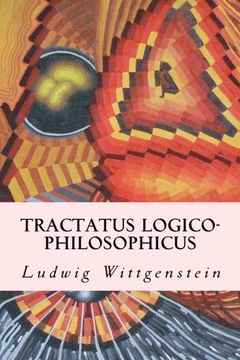
portada Tractatus Logico-Philosophicus
Type
Physical Book
Publisher
Language
English
Pages
64
Format
Paperback
Dimensions
22.9x15.2x0.3 cm
Weight
0.10 kg.
ISBN13
9781502551382

Tractatus Logico-Philosophicus

Ludwig Wittgenstein (Author) · Createspace · Paperback

Tractatus Logico-Philosophicus - Ludwig Wittgenstein

New Book Imported to Austria
Delivery: 23 Sep - 30 Sep Shipping: 16 to 20 business days.
21,28 €
Import costs and 10% VAT included in the price ✅
21,28 €

Synopsis "Tractatus Logico-Philosophicus"

The Tractatus Logico-Philosophicus (TLP) (Latin for "Logico-Philosophical Treatise") is the only book-length philosophical work published by the Austrian philosopher Ludwig Wittgenstein in his lifetime. The project had a broad aim - to identify the relationship between language and reality and to define the limits of science[1] - and is recognized as a significant philosophical work of the twentieth century. G. E. Moore originally suggested the work's Latin title as homage to the Tractatus Theologico-Politicus by Baruch Spinoza.[2] Wittgenstein wrote the notes for the Tractatus while he was a soldier during World War I and completed it during a military leave in the summer of 1918.[3] It was first published in German in 1921 as Logisch-Philosophische Abhandlung. The Tractatus was influential chiefly amongst the logical positivists of the Vienna Circle, such as Rudolf Carnap and Friedrich Waismann. Bertrand Russell's article "The Philosophy of Logical Atomism" is presented as a working out of ideas that he had learned from Wittgenstein. The Tractatus employs a notoriously austere and succinct literary style. The work contains almost no arguments as such, but rather consists of declarative statements, or passages, that are meant to be self-evident. The statements are hierarchically numbered, with seven basic propositions at the primary level (numbered 1-7), with each sub-level being a comment on or elaboration of the statement at the next higher level (e.g., 1, 1.1, 1.11, 1.12, 1.13). In all, the Tractatus comprises 526 numbered statements, with 1, 2, 3, 4, 5, 6 and 7 having 7, 79, 74, 109, 151, 105 and 1 associated statement(s), respectively. Wittgenstein's later works, notably the posthumously published Philosophical Investigations, criticised many of the ideas in the Tractatus. Wittgenstein concluded that the Tractatus had resolved all philosophical problems. The book was translated into English by C. K. Ogden with help from the teenaged Cambridge mathematician and philosopher Frank P. Ramsey. Ramsey later visited Wittgenstein in Austria. Translation issues make the concepts hard to pinpoint, especially given Wittgenstein's usage of terms and difficulty in translating ideas into words.[25] The Tractatus caught the attention of the philosophers of the Vienna Circle (1921-1933), especially Rudolf Carnap and Moritz Schlick. The group spent many months working through the text out loud, line by line. Schlick eventually convinced Wittgenstein to meet with members of the circle to discuss the Tractatus when he returned to Vienna (he was then working as an architect). Although the Vienna Circle's logical positivists appreciated the Tractatus, they argued that the last few passages, including Proposition 7, are confused. Carnap hailed the book as containing important insights, but encouraged people to ignore the concluding sentences. Wittgenstein responded to Schlick, commenting: "...I cannot imagine that Carnap should have so completely misunderstood the last sentences of the book and hence the fundamental conception of the entire book. A more recent interpretation comes from The New Wittgenstein family of interpretations under development since 2000.[27] This so-called "resolute reading" is controversial and much debated.[citation needed] The main contention of such readings is that Wittgenstein in the Tractatus does not provide a theoretical account of language that relegates ethics and philosophy to a mystical realm of the unsayable. Rather, the book has a therapeutic aim. By working through the propositions of the book the reader comes to realize that language is perfectly suited to all his needs, and that philosophy rests on a confused relation to the logic of our language. The confusion that the Tractatus seeks to dispel is not a confused theory, such that a correct theory would be a proper way to clear the confusion, rather the need of any such theory is confused.
Ludwig Wittgenstein
  (Author)
View Author's Page
Ludwig Wittgenstein (1889–1951) was an influential Austrian philosopher, considered one of the most prominent figures in twentieth-century thought. He was born in Vienna into a wealthy and intellectual family. He studied engineering in Berlin and then at the University of Cambridge, where he met philosopher Bertrand Russell, who introduced him to the world of logical philosophy.

His first major work, Tractatus Logico-Philosophicus (1921), seeks to establish the limits of language and thought, proposing that what cannot be clearly stated should be silenced. This work made him a prominent figure in the Vienna Circle and analytic philosophy. After its publication, he temporarily retired from philosophy to work as a rural teacher and gardener.

Years later, he resumed his philosophical activity with a radically different approach, which was reflected in his posthumous work Philosophical Investigations. There, he criticizes his earlier ideas and proposes that the meaning of language arises from its use in social contexts, a theory that deeply influenced linguistics, psychology, and the social sciences.

Wittgenstein lived austerely and dedicated almost exclusively to philosophy. He died in 1951 in Cambridge, leaving a lasting and debated legacy. Would you like a timeline with his main works?
See more
See less

Customers reviews

Frequently Asked Questions about the Book

All books in our catalog are Original.
The book is written in English.
The binding of this edition is Paperback.

Questions and Answers about the Book

Do you have a question about the book? Login to be able to add your own question.

Opinions about Bookdelivery

More customer reviews