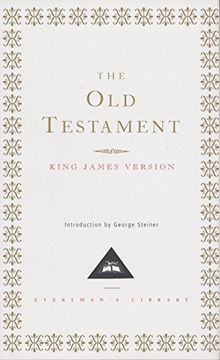
The King James Version of the Bible, first published in 1611, has been the favorite of English readers for centuries. This Everyman's Library edition of The Old Testament also contains George Steiner's introduction which reminds us of the literary grandeur, uniqueness, and centrality of the Bible. "What you have in hand is not a book. It is the book. That, of course, is what 'Bible' means. It is the book which, not only in Western humanity, defines the concept of a text. All our other books, however different in matter or method, relate, be it indirectly, to this book of books... "All other books, be they histories, narrations of the imaginary, codes of law, moral treatises, lyric poems, dramatic dialogues, theological-philosophic meditations, are like sparks, often, to be sure, distant, tossed by an incessant breath from a central fire. In the Western condition, but also in other parts of the planet to which the 'Good Book' has been taken, the Bible largely informs our historical and social identity... "No other book is like it; all other books are inhabited by the murmer of that distant source." Steiner underlines, as well, our great good fortune in being able to read the Bible--which has been translated in whole or in part into more than two thousand languages--in the resplendent language of seventeenth-century England. "This is the instrument of Spenser, of Shakespeare, of Bacon, of Donne and the young Milton. It encompasses the organblasts of the Queen's rhetoric, Sidney's intimacies of desire, the 'lapidary lightness' of Ben Jonson, and the compaction of the early Metaphysical poets. It can command, seduce, enchant, and think aloud as never before or since...There could not have been a moment, a climate of feeling and general discourse, more apt to engender the two foremost constructs in the language: Shakespeare and the King James Version."
De nombre Francis George Steiner, nació en una familia de origen judío procedente de Austria. Estudió en el Liceo Janson-de-Sailly, y en el año 1940, huyendo de los nazis, su familia emigró a Estados Unidos, concretamente a Nueva York. Allí estudió en el Liceo Francés, y más tarde se graduaría en Literatura, Matemáticas y Física en la Universidad de Chicago, obteniendo un master en la de Harvard y doctorado en Literatura en el Balliol College de la Universidad de Oxford. Fue profesor en el Williams College de la misma, y editorialista de The Economist. En 1956 marchó a Estados Unidos, y fue profesor en el Instituto de Estudios Avanzados de Princeton, pasando, dos años después a serlo en la Universidad de Innsbruck y a continuación en el Churchill College de la Universidad de Cambridge. Años más tarde, marcharía a la Universidad de Ginebra, en la que durante veinte años, sería profesor de Literatura Comparada. Ha acabado su vida docente enseñando en las universidades de Oxford y Harvard. Durante treinta años, ha colaborado en The New Yorker, y también lo ha hecho en el suplemento literario de Times y en The Guardian. Ha recibido numerosos honores y reconocimientos, como el Premio Príncipe de Asturias de Comunicación y Humanidades en el año 2001, y doctorados Honoris Causa por numerosas universidades. Es Caballero de la Orden de la Legión de Honor, en Francia.