Hallo! Tracked shipping to Austria with Delivery Duty Paid for just €3.99  

Ship to
Austria
0
  • argentina
  • chile
  • colombia
  • españa
  • méxico
  • perú
  • estados unidos
  • internacional

Select your country

Americas

Europe

Rest of the world

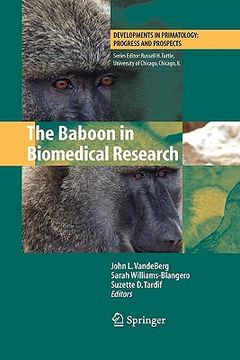
portada the baboon in biomedical research
Type
Physical Book
Publisher
Year
2010
Language
English
Pages
392
Format
Paperback
Dimensions
23.4 x 15.6 x 2.2 cm
Weight
0.58 kg.
ISBN
1441926151
ISBN13
9781441926159

the baboon in biomedical research

John L. Vandeberg (Illustrated by) · Sarah Williams-Blangero (Illustrated by) · Suzette D. Tardif (Illustrated by) · Springer · Paperback

the baboon in biomedical research - Vandeberg, John L. ; Williams-Blangero, Sarah ; Tardif, Suzette D.

Cheaper New Book Imported to Austria
Delivery: 03 Sep - 10 Sep Shipping: 12 to 16 business days.
178,45 €
Faster New Book Imported to Austria
Delivery: 21 Aug - 25 Aug Shipping: 4 to 5 business days.
307,69 €
Import costs and 10% VAT included in the price ✅
178,45 €

Synopsis "the baboon in biomedical research"

Nonhuman primates have played critical roles in biomedical research, and they are among the few animals whose use in research continues to increase. The scienti?c value of nonhuman primates derives from their close phylogenetic proximity to man and their consequent anatomic, physiologic, and genetic similarities to man. Only nonhuman primates can provide adequate models for many complex physiological and disease processes of humans. The baboon is a relative newcomer to the repertoire of nonhuman primates used in biomedical research. However, in less than 50 years since its ?rst use in the U. S., it has become one of the most popular laboratory primate species. It is larger than the other widely used monkey species, making it advantageous for many types of experiments and technological developments. It is extraordinarily hardy and highly fecund in captivity. It closely resembles humans in a variety of physiological and disease processes, such as cholesterol metabolism, early stages of atherosclerosis, and alcoholic liver disease. Its chromosomes closely resemble those of humans, and many genes of the two species lie in the same chromosomal order. Among all primates, baboons are the most widely used models for the genetics of susceptibility to complex diseases and they are the ?rst nonhuman primate for which a framework genetic linkage map was established. In addition, the baboon genome is currently being sequenced, and as a result the utility of this species for biomedical research will be dramatically increased.

Customers reviews

Frequently Asked Questions about the Book

All books in our catalog are Original.
The book is written in English.
The binding of this edition is Paperback.

Questions and Answers about the Book

Do you have a question about the book? Login to be able to add your own question.

Opinions about Bookdelivery

More customer reviews