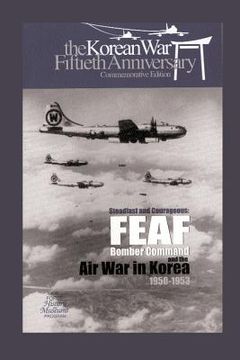
Steadfast and Courageous: FEAF Bomber Command and the Air War in Korea, 1950-1953
Museums Program, Air Force Hisotry and
Synopsis "Steadfast and Courageous: FEAF Bomber Command and the Air War in Korea, 1950-1953"
For three years, beginning in June 1950, air and ground crews of the United States Air Force (USAF) conducted bombing operations with Boeing B-29 Superfortresses in support of the United Nations (U.N.) forces engaged on the peninsula of Korea. Powered by four large radial piston engines, the propeller- driven Superfortress had been the most advanced very long-range heavy bomber developed during the Second World War. But such had been the pace of aeronautical development since the Second World War that it was now, at the time of Korea, considered but a medium bomber, and one outclassed by early jet aircraft at that. Manned principally by officers and men from the Strategic Air Command (SAC), the B-29 units carried out missions very different from the task for which SAC was trained. Instead of striking at the homeland of a major industrial power with ATOMIC weapons, the crews at- tacked targets of many types, showing the variety of functions that air power could perform. The bombers carried out battlefield support, interdiction, and air superiority (counter airfield) missions. They hit industrial targets of the type normally classified as strategic and also took part in an effort to utilize air power to pressure the enemy to agree to a cease-fire. This study traces the war fought by Far East Air Forces (FEAF) Bomber Command (Provisional), the B-29 force created to attack targets in Korea from bases in Okinawa and Japan. Consisting of units belonging to FEAF and others from SAC assigned on temporary duty, Bomber Command cooperated with other USAF organizations to support operations in the Korean peninsula. The B-29 crews earned credit in all ten of the recognized campaigns of the Korean War. Politically, the war had three phases. From June 25, 1950, when North Koreans attacked South Korea, until November 2, 1950, U.N. forces defended the south and defeated the invaders. From November 1950 until July 1951, the U.N. had to deal with the intervention of Communist China and the most desperate fighting of the war. Beginning on July 10, 1951, fighting continued even as negotiations for a cease-fire between the opposing military commands were under way. This third phase, and the war, ended when the armistice was signed on July 27, 1953. As for actual combat operations, however, Bomber Command experienced the war in terms of the opposition it encountered. Following a brief but intensive air superiority war in the summer of 1950, North Korea posed negligible air opposition, but when the Chinese entered the war in November, assisted by Soviet fighter pilots flying MiG-15 jet fighters, the limitations of the obsolescent B-29s became apparent. Communist air resistance was so heavy that by the end of October 1951 the B-29s had switched to a remarkable night campaign that continued for more than a year and a half. By 1953, SAC was well on the way to removing the B-29s from its inventory. Thus, for one last time, the B-29, a workhorse of the air campaign in the Pacific in World War II, flew into combat. Often called a "police action," or the "Korean conflict," the fighting in Korea was undertaken under the leadership of the United States on the authority of the U.N., to defend the Republic of Korea against the Communist North Koreans and Chinese and their Soviet supporters. Thus, it differed significantly from previous conflicts, which had been typified by formal declarations of war by the Congress. This semantic uncertainty well reflects the unprecedented situation that American fighting men faced in the Far East. For Bomber Command, the contrast between what a strategic bomber like the B-29 had been designed for and what it actually did clearly illustrates the anomalies.