Hallo! Tracked shipping to Austria with Delivery Duty Paid for just €3.99  

Ship to
Austria
0
  • argentina
  • chile
  • colombia
  • españa
  • méxico
  • perú
  • estados unidos
  • internacional

Select your country

Americas

Europe

Rest of the world

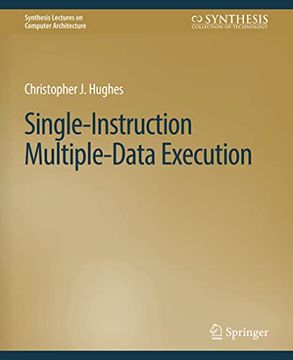
portada Single-Instruction Multiple-Data Execution
Type
Physical Book
Publisher
Language
English
Pages
105
Format
Paperback
Dimensions
23.5 x 19.1 x 0.7 cm
Weight
0.23 kg.
ISBN13
9783031006180
Edition No.
1

Single-Instruction Multiple-Data Execution

Christopher J. Hughes (Author) · Springer · Paperback

Single-Instruction Multiple-Data Execution - Hughes, Christopher J.

Cheaper New Book Imported to Austria
Delivery: 28 Aug - 07 Sep Shipping: 13 to 17 business days.
59,50 €
Faster New Book Imported to Austria
Delivery: 18 Aug - 20 Aug Shipping: 5 to 6 business days.
72,55 €
Import costs and 10% VAT included in the price ✅
59,50 €

Synopsis "Single-Instruction Multiple-Data Execution"

Having hit power limitations to even more aggressive out-of-order execution in processor cores, many architects in the past decade have turned to single-instruction-multiple-data (SIMD) execution to increase single-threaded performance. SIMD execution, or having a single instruction drive execution of an identical operation on multiple data items, was already well established as a technique to efficiently exploit data parallelism. Furthermore, support for it was already included in many commodity processors. However, in the past decade, SIMD execution has seen a dramatic increase in the set of applications using it, which has motivated big improvements in hardware support in mainstream microprocessors. The easiest way to provide a big performance boost to SIMD hardware is to make it wider--i.e., increase the number of data items hardware operates on simultaneously. Indeed, microprocessor vendors have done this. However, as we exploit more data parallelism in applications, certain challenges can negatively impact performance. In particular, conditional execution, non-contiguous memory accesses, and the presence of some dependences across data items are key roadblocks to achieving peak performance with SIMD execution. This book first describes data parallelism, and why it is so common in popular applications. We then describe SIMD execution, and explain where its performance and energy benefits come from compared to other techniques to exploit parallelism. Finally, we describe SIMD hardware support in current commodity microprocessors. This includes both expected design tradeoffs, as well as unexpected ones, as we work to overcome challenges encountered when trying to map real software to SIMD execution.

Customers reviews

Frequently Asked Questions about the Book

All books in our catalog are Original.
The book is written in English.
The binding of this edition is Paperback.

Questions and Answers about the Book

Do you have a question about the book? Login to be able to add your own question.

Opinions about Bookdelivery

More customer reviews