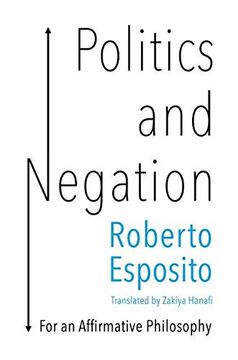
Politics and Negation: For an Affirmative Philosophy
Roberto Esposito
Synopsis "Politics and Negation: For an Affirmative Philosophy "
For some while we have been witnessing a series of destructive phenomena which seem to indicate a full-fledged return to the negative on the world stage – from terrorism and armed conflict to the threat of environmental catastrophe. At the same time, politics seems increasingly impotent in the face of these threats. In this book, the leading Italian philosopher Roberto Esposito reconstructs the genealogy of the reciprocal intertwining of politics and negation. He retraces the intensification of negation in the thought of various thinkers, from Schmitt and Freud to Heidegger, and examines the negative slant of some of our fundamental political categories, such as sovereignty, property and freedom. Against the centrality of negation, Esposito proposes an affirmative philosophy that does not negate or repress negation but radically rethinks it in the positive cipher of difference, determination and opposition. The result is a rigorous and original pathway which, in the tension between affirmation and negation, recognizes the disturbing traumas of our time, as well as the harbingers of what awaits at its limits. This highly original and timely book will be of great value to students and scholars in philosophy, cultural theory and the humanities more generally, and to anyone interested in contemporary European thought.
Roberto Esposito, nacido el 4 de agosto de 1950 en Piano di Sorrento, Italia, es un filósofo contemporáneo destacado en el ámbito de la filosofía política y la teoría crítica. Es reconocido por sus estudios sobre biopolítica y por haber desarrollado conceptos clave que exploran la relación entre la vida, la comunidad y la política. Su carrera académica se ha desarrollado principalmente en la Scuola Normale Superiore de Pisa, donde ha enseñado filosofía teórica, y ha tenido influencia internacional en la reflexión sobre el poder y la sociedad contemporánea. Entre sus aportes más importantes se encuentra la reinterpretación de nociones como communitas e immunitas. La primera no se entiende como una comunidad tradicional, sino como una experiencia de compartir y exponerse a lo común, mientras que la segunda representa la lógica de protección que, al separarse de lo común, puede volverse autodestructiva. A partir de estas ideas, Esposito analiza cómo la vida política y la biológica se entrelazan, planteando que los mecanismos de protección social y política pueden derivar en procesos que ponen en riesgo aquello que buscan preservar. Su obra ha renovado la reflexión sobre la democracia, la vulnerabilidad, la gestión de la vida y las relaciones entre individuo y colectivo. Con un enfoque que conecta filosofía, política y ética, Esposito se ha consolidado como una de las voces más influyentes para comprender los desafíos del mundo contemporáneo.