Hallo! Tracked shipping to Austria with Delivery Duty Paid for just €3.99  

Ship to
Austria
0
  • argentina
  • chile
  • colombia
  • españa
  • méxico
  • perú
  • estados unidos
  • internacional

Select your country

Americas

Europe

Rest of the world

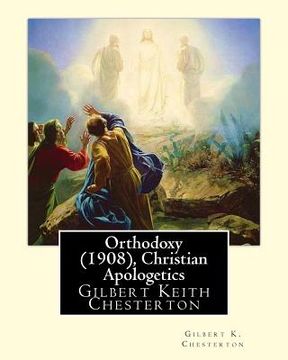
portada Orthodoxy (1908), By Gilbert K. Chesterton ( Christian Apologetics ): Gilbert Keith Chesterton
Type
Physical Book
Publisher
Language
English
Pages
92
Format
Paperback
Dimensions
25.4 x 20.3 x 0.5 cm
Weight
0.20 kg.
ISBN13
9781535049559

Orthodoxy (1908), By Gilbert K. Chesterton ( Christian Apologetics ): Gilbert Keith Chesterton

G. K. Chesterton (Author) · Gilbert Chesterton (Author) · Createspace · Paperback

Orthodoxy (1908), By Gilbert K. Chesterton ( Christian Apologetics ): Gilbert Keith Chesterton - Gilbert Chesterton

Out of Stock

Synopsis "Orthodoxy (1908), By Gilbert K. Chesterton ( Christian Apologetics ): Gilbert Keith Chesterton"

Orthodoxy (1908) is a book by G. K. Chesterton that has become a classic of Christian apologetics. Chesterton considered this book a companion to his other work, Heretics, writing it expressly in response to G.S. Street's criticism of the earlier work, "that he was not going to bother about his theology until I had really stated mine".In the book's preface Chesterton states the purpose is to "attempt an explanation, not of whether the Christian faith can be believed, but of how he personally has come to believe it." In it, Chesterton presents an original view of Christian religion. He sees it as the answer to natural human needs, the "answer to a riddle" in his own words, and not simply as an arbitrary truth received from somewhere outside the boundaries of human experience. The book was written when Chesterton was an Anglican. He converted to Catholicism 14 years later. Chesterton chose the title, Orthodoxy, to focus instead on the plainness of the Apostles' Creed, though he admitted the general sound of the title was "a thinnish sort of thing". Chesterton (The Man Who Knew Too Much) capped his brilliant literary career with this exploration of "right thinking," and how it led to his acceptance of the Christian faith. Although this is a very personal account of his conversion, Chesterton makes it clear he came to a rational decision based upon his scholarly examination of Christianity's arguments, intending to provide a "positive" companion to the previous Heretics.... Gilbert Keith Chesterton, KC*SG (29 May 1874 - 14 June 1936), better known as G. K. Chesterton, was an English writer, poet, philosopher, dramatist, journalist, orator, lay theologian, biographer, and literary and art critic. Chesterton is often referred to as the "prince of paradox."Time magazine has observed of his writing style: "Whenever possible Chesterton made his points with popular sayings, proverbs, allegories-first carefully turning them inside out." Chesterton is well known for his fictional priest-detective Father Brown, and for his reasoned apologetics. Even some of those who disagree with him have recognized the wide appeal of such works as Orthodoxy and The Everlasting Man.Chesterton, as a political thinker, cast aspersions on both Progressivism and Conservatism, saying, "The whole modern world has divided itself into Conservatives and Progressives. The business of Progressives is to go on making mistakes. The business of the Conservatives is to prevent the mistakes from being corrected."Chesterton routinely referred to himself as an "orthodox" Christian, and came to identify this position more and more with Catholicism, eventually converting to Catholicism from High Church Anglicanism. George Bernard Shaw, Chesterton's "friendly enemy" according to Time, said of him, "He was a man of colossal genius." Biographers have identified him as a successor to such Victorian authors as Matthew Arnold, Thomas Carlyle, Cardinal John Henry Newman, and John Ruski
G. K. Chesterton
  (Author)
View Author's Page
G. K. Chesterton (London, May 29, 1874 – Beaconsfield, June 14, 1936) was a prolific British writer, author of essays, novels, poetry, biographies, and Christian apologetics. His work is characterized by irony, paradoxical wit, and a critical view of modernity. He was a prominent convert to Catholicism and an influential figure in religious and literary thought of his time. He is also known for his brilliant argumentative style and his defense of common sense.

Among his most recognized works are The Man Who Was Thursday (1908), Orthodoxy (1908), The Innocence of Father Brown (1911), Heretics (1905), The Ball and the Cross (1909), and The Resurrection of Rome (1930). He cultivated the essay, the novel of ideas, detective stories, and social and religious criticism.
See more
See less
Gilbert Chesterton
  (Author)
View Author's Page
G.K. Chesterton (1874-1936) fue un prolífico escritor, periodista y pensador británico, conocido por su ingenio, paradojas y defensa de la fe cristiana, especialmente tras convertirse al catolicismo en 1922; fue un maestro en géneros como el ensayo, la poesía y la novela, creando al famoso detective Padre Brown, y dejando una vasta obra que incluía crítica, biografía y reflexiones filosóficas, convirtiéndose en una figura influyente de la literatura anglosajona
See more
See less

Customers reviews

Frequently Asked Questions about the Book

All books in our catalog are Original.
The book is written in English.
The binding of this edition is Paperback.

Questions and Answers about the Book

Do you have a question about the book? Login to be able to add your own question.

Opinions about Bookdelivery

More customer reviews