
Ship to
Austria
Select your location
Shipping costs will be calculated based on this address throughout the site.
Shipping costs will be calculated based on this address throughout the site.
Select your country
Americas
Argentina
Brazil
Canada
Chile
Colombia
Costa Rica
Dominican Republic
Ecuador
El Salvador
Mexico
Peru
U.S.A.
Uruguay
Europe
Austria
Belgium
Croatia
Czech Republic
Denmark
Finland
France
Germany
Greece
Hungary
Ireland
Italy
Latvia
Malta
Netherlands
Norway
Poland
Portugal
Serbia
Slovakia
Slovenia
Spain
Sweden
Switzerland
United Kingdom
Rest of the world
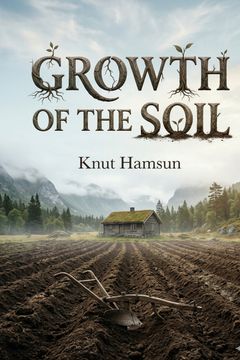
Growth of the Soil
Knut Hamsun
Growth of the Soil
Knut Hamsun (Author) · Les prairies numériques · Paperback
Growth of the Soil
Knut Hamsun
Growth of the Soil
Growth of the Soil was published in 1917 to universal acclaim. A mid- to late-career work for Hamsun, it was celebrated for its then-revolutionary use of literary techniques like stream of consciousness, and for its unadorned depiction of pastoral life. Its focus on the quotidian lives of everyday people has led scholars to classify it as a novel of Norwegian New Realism.Isak, a man so strong and so simple that he echoes a primitive, foundational "everyman," finds an empty plot of land in turn-of-the-century Norway, and builds a small home. He soon attracts a wife, Inger, whose harelip has led her to be ostracized from town life but who is nonetheless a hard and conscientious worker. Together the two earthy beings build a farm and a family, and watch as society and civilization grows and develops around them.Isak and Inger's toils sometimes bring them up against the burgeoning modernity around them, but curiously, the novel is not one driven by a traditional conflict-oriented plot. Instead, the steady progression of life on the farm, with its ups and downs, its trials and joys, makes the people and their growth the novel's main propellant. While the humble, homespun protagonists occasionally come into conflict with the awe-inspiring forces of civilization, more often than not, those forces are portrayed as positive and symbiotic companions to the agrarian lifestyle.Hamsun was awarded the Nobel Prize in Literature in 1920 for Growth of the Soil, one of the rare instances in which the Nobel committee awarded a prize for a specific novel, and not a body of work. It has since come to be regarded as a classic of modernist, and Norwegian, literature.
Do you have a question about the book? Login to be able to add your own question.