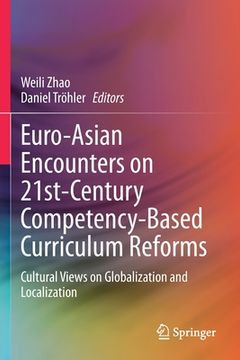
Euro-Asian Encounters on 21st-Century Competency-Based Curriculum Reforms: Cultural Views on Globalization and Localization - Zhao, Weili ; Tröhler, Daniel
Cheaper New Book
Imported
to Austria
Delivery: 19 Aug - 26 Aug
Shipping: 12 to 16 business days.
158,18 €
Faster New Book
Imported
to Austria
Delivery: 07 Aug - 11 Aug
Shipping: 4 to 5 business days.
195,21 €
Import costs and 10% VAT included in the price ✅
158,18 €
195,21 €
Choose the list to add your product or create one New List
Euro-Asian Encounters on 21st-Century Competency-Based Curriculum Reforms: Cultural Views on Globalization and Localization
Zhao, Weili ; Tröhler, Daniel
Synopsis "Euro-Asian Encounters on 21st-Century Competency-Based Curriculum Reforms: Cultural Views on Globalization and Localization"
This book offers a geographically unique cultural comparative lens to examine the issue of transnational curriculum knowledge (re)production. Prompted by the ongoing competency-based curriculum reforms on a global scale, this book examines where global frameworks like the OECD's core competency definitions are rooted and how they are borrowed, resisted, and/or re-contextualized in various European states with a Christian, foremost Protestant educational-cultural heritage and Asian countries with a Confucian educational-cultural heritage. It highlights the roles that various factors, such as history, culture, religious attitudes, ideology, and state governance play in nation-states' re-contextualization of global curriculum policies and practices beyond a simplistic and dualistic globalism/power and nationalism/resistance dynamic. In doing so, it provides a global context to better understand individual nation-state's continuing curriculum reforms and school practices. At the same time, it situates individual nation-state's latest curriculum reforms and practices within an international community for healthy dialogues and mutual sharing. By selecting two educational-cultural systems and wisdom-Christian-Protestant and Confucian-it also offers a springboard for international curriculum studies beyond the usual confinement of geopolitical nation-state constructs. It not only sheds new light on each nation-state's curriculum policies and practices, but also creates new collaboration spaces within similar and across disparate cultural-educational regions. With its wide geopolitical and educational-cultural scope, this book appeals to a global market and can be used in a variety of undergraduate and graduate courses in comparative education, history of education, curriculum theory, school and society, and curriculum history.