Hallo! Tracked shipping to Austria with Delivery Duty Paid for just €3.99  

Ship to
Austria
0
  • argentina
  • chile
  • colombia
  • españa
  • méxico
  • perú
  • estados unidos
  • internacional

Select your country

Americas

Europe

Rest of the world

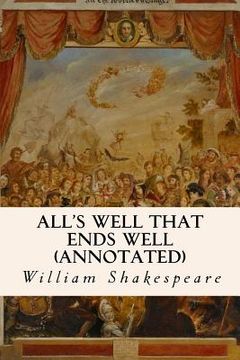
portada All's Well That Ends Well (annotated)
Type
Physical Book
Publisher
Language
English
Pages
136
Format
Paperback
Dimensions
22.9x15.2x0.7 cm
Weight
0.19 kg.
ISBN13
9781530821198

All's Well That Ends Well (annotated)

William Shakespeare (Author) · Createspace · Paperback

All's Well That Ends Well (annotated) - William Shakespeare

New Book Imported to Austria
Delivery: 21 Sep - 28 Sep Shipping: 17 to 21 business days.
22,43 €
Import costs and 10% VAT included in the price ✅
22,43 €

Synopsis "All's Well That Ends Well (annotated)"

All's Well That Ends Well is a play by William Shakespeare. It is believed to have been written between 1604 and 1605, and was originally published in the First Folio in 1623. Though originally the play was classified as one of Shakespeare's comedies, the play is now considered by some critics to be one of his problem plays, so named because they cannot be neatly classified as tragedy or comedy. There is no evidence that All's Well was popular in Shakespeare's own lifetime and it has remained one of his lesser-known plays ever since, in part due to its unorthodox mixture of fairy tale logic, gender role reversals and cynical realism. Helena's love for the seemingly unlovable Bertram is difficult to explain on the page, but in performance it can be made acceptable by casting an actor of obvious physical attraction or by playing him as a naive and innocent figure not yet ready for love although, as both Helena and the audience can see, capable of emotional growth.[6] This latter interpretation also assists at the point in the final scene in which Bertram suddenly switches from hatred to love in just one line. This is considered a particular problem for actors trained to admire psychological realism. However, some alternative readings emphasise the "if" in his equivocal promise: "If she, my liege, can make me know this clearly, I'll love her dearly, ever, ever dearly." Here, there has been no change of heart at all.[7] Productions like the National Theatre's 2009 run, have Bertram make his promise seemingly normally, but then end the play hand-in-hand with Helena, staring out at the audience with a look of "aghast bewilderment" suggesting he only relented to save face in front of the King.[8] A 2018 interpretation from director Caroline Byrne at the Sam Wanamaker Playhouse, London, effects Bertram's reconciliation with Helena by having him make good his vow (Act 2 Scene 2) of only taking her as his wife when she bears his child; as well as Bertram's ring, Helena brings their infant child to their final confrontation before the king. Many critics consider that the truncated ending is a drawback, with Bertram's conversion so sudden. Various explanations have been given for this. There is (as always) possibly missing text. Some suggest that Bertram's conversion is meant to be sudden and magical in keeping with the 'clever wench performing tasks to win an unwilling higher born husband' theme of the play.[10] Some consider that Bertram is not meant to be contemptible, merely a callow youth learning valuable lessons about values.[11] Contemporary audiences would readily have recognised Bertram's enforced marriage as a metaphor for the new requirement (1606), directed at followers of the Catholic religion, to swear an Oath of Allegiance to Protestant King James, suggests academic Andrew Hadfield of the University of Sussex. Many directors have taken the view that when Shakespeare wrote a comedy, he did intend there to be a happy ending, and accordingly that is the way the concluding scene should be staged. Elijah Moshinsky in his acclaimed BBC version in 1981 had his Bertram (Ian Charleson) give Helena a tender kiss and speak wonderingly. Despite his outrageous actions, Bertram can come across as beguiling; the filming of the 1967 RSC performance with Ian Richardson as Bertram has been lost, but by various accounts (The New Cambridge Shakespeare, 2003 etc.) he managed to make Bertram sympathetic, even charming. Ian Charleson's Bertram was cold and egotistical but still attractive.
William Shakespeare
  (Author)
View Author's Page
William Shakespeare (Stratford-upon-Avon, c. April 23, 1564jul. - Ibid., April 23/May 3, 1616) was an English playwright, poet, and actor. Often known as the Bard of Avon (or simply the Bard), he is considered the most important writer in the English language and one of the most famous in world literature.

According to the Encyclopædia Britannica, "Shakespeare is generally acknowledged as the greatest of all time writers, a unique figure in the history of literature. The fame of other poets, such as Homer and Dante Alighieri, or novelists such as Leo Tolstoy or Charles Dickens, has transcended national barriers, but none has achieved the reputation of Shakespeare, whose works today are read and performed more frequently and in more countries than ever. The prophecy of one of his great contemporaries, Ben Jonson, has thus been fulfilled: 'Shakespeare does not belong to one age but to eternity'".

Among his most notable works are Hamlet, Romeo and Juliet, Macbeth, and A Midsummer Night's Dream. His ability to portray the complexities of human nature, along with his mastery in the use of verse and language, has made him a timeless figure.
See more
See less

Customers reviews

Frequently Asked Questions about the Book

All books in our catalog are Original.
The book is written in English.
The binding of this edition is Paperback.

Questions and Answers about the Book

Do you have a question about the book? Login to be able to add your own question.

Opinions about Bookdelivery

More customer reviews