Ship to
Austria
0
  • argentina
  • chile
  • colombia
  • españa
  • méxico
  • perú
  • estados unidos
  • internacional

Select your country

Americas

Europe

Rest of the world

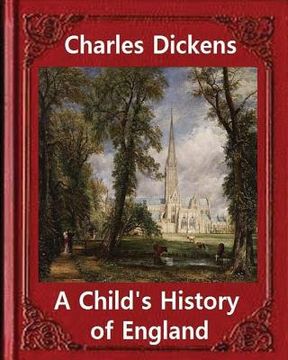
portada A Child's History of England, by Charles Dickens: Great Britain -- History Juvenile literature, genealogy
Type
Physical Book
Publisher
Language
English
Pages
232
Format
Paperback
Dimensions
25.4 x 20.3 x 1.2 cm
Weight
0.47 kg.
ISBN13
9781533581754

A Child's History of England, by Charles Dickens: Great Britain -- History Juvenile literature, genealogy

Charles Dickens (Author) · Createspace · Paperback

A Child's History of England, by Charles Dickens: Great Britain -- History Juvenile literature, genealogy - Charles Dickens

New Book Imported to Austria
Delivery: 21 Aug - 28 Aug Shipping: 16 to 20 business days.
22,14 €
Import costs and 10% VAT included in the price ✅
22,14 €

Synopsis "A Child's History of England, by Charles Dickens: Great Britain -- History Juvenile literature, genealogy"

A Child's History of England is a book by Charles Dickens which appeared first in serial form in Household Words, running from January 25, 1851 to December 10, 1853. It was published in three-volume book form from 1852 to 1854. The history covered the period between 50 BC and 1689, ending with a chapter summarising events from then until the accession of Queen Victoria. When the people found that they were none the better for the blessings of the Druids, and none the worse for the curses of the Druids, but, that the sun shone and the rain fell without consulting the Druids at all, they just began to think that the Druids were mere men, and that it signified very little whether they cursed or blessed. After which, the pupils of the Druids fell greatly off in numbers, and the Druids took to other trades. Ch. I: Ancient England and the Romans Some became Crusaders for the love of change; some, in the hope of plunder; some, because they had nothing to do at home; some, because they did what the priests told them; some, because they liked to see foreign countries; some, because they were fond of knocking men about, and would as soon knock a Turk about as a Christian. Ch. IX: England under William the Second, Called Rufus Courtiers are not only eager to laugh when the King laughs, but they really do enjoy a laugh against a Favourite. Ch. XII: England under Henry the Second: Part the First In the year of our Lord one thousand one hundred and eighty-nine, Richard of the Lion Heart succeeded to the throne of King Henry the Second, whose paternal heart he had done so much to break. He had been, as we have seen, a rebel from his boyhood; but, the moment he became a king against whom others might rebel, he found out that rebellion was a great wickedness. In the heat of this pious discovery, he punished all the leading people who had befriended him against his father. He could scarcely have done anything that would have been a better instance of his real nature, or a better warning to fawners and parasites not to trust in lion-hearted princes. War is a dreadful thing; and it is appalling to know how the English were obliged, next morning, to kill those prisoners mortally wounded, who yet writhed in agony upon the ground; how the dead upon the French side were stripped by their own countrymen and countrywomen, and afterwards buried in great pits; how the dead upon the English side were piled up in a great barn, and how their bodies and the barn were all burned together. It is in such things, and in many more much too horrible to relate, that the real desolation and wickedness of war consist. Nothing can make war otherwise than horrible. But the dark side of it was little thought of and soon forgotten; and it cast no shade of trouble on the English people, except on those who had lost friends or relations in the fight. They welcomed their King home with shouts of rejoicing, and plunged into the water to bear him ashore on their shoulders, and flocked out in crowds to welcome him in every town through which he passed, and hung rich carpets and tapestries out of the windows, and strewed the streets with flowers, and made the fountains run with wine, as the great field of Agincourt had run with blood. ...
Charles Dickens
  (Author)
View Author's Page
Charles Dickens (February 7, 1812 - June 9, 1870) was born in Portsmouth and was the eldest son of a Royal Navy clerk. At twelve, his father's imprisonment for debt forced him to work in a blacking factory. His education was sporadic: he taught himself shorthand, worked as a clerk in a law office, and eventually became a parliamentary correspondent for the Morning Chronicle.

Coming from a humble family, "good old Charles" did not receive formal education until he was nine, and was heavily criticized by the critics of the time for being too self-taught. His life took an unexpected turn with his father's imprisonment for debts, moving his family to live with him in jail, allowed at that time by British laws. At the age of 12, he was already considered fit to start working in a dye factory. Although his family's situation had improved, his mother insisted he keep working there, inspiring him to write one of his masterpieces, David Copperfield.

His articles, later collected in Scenes from London Life by "Boz" (1836-1837), were very successful, and with the appearance in 1837 of The Posthumous Papers of the Pickwick Club, Dickens became a true publishing phenomenon. Novels such as Oliver Twist (1837-1839), Nicholas Nickleby (1838-1839), and Barnaby Rudge (1841) gained enormous popularity, as did some travel chronicles, such as Pictures from Italy (1846). With Dombey and Son (1846-1848) he began his mature period, of which good examples are David Copperfield (1849-1850), his first novel in the first person and his favorite, in which he developed some autobiographical episodes; Bleak House (1852-1853); Little Dorrit (1855-1857), A Tale of Two Cities (1859), Great Expectations (1860-1861), and Our Mutual Friend (1864-1865). He died at Gad's Hill, his country house in Higham, in the county of Kent.
See more
See less

Customers reviews

Frequently Asked Questions about the Book

All books in our catalog are Original.
The book is written in English.
The binding of this edition is Paperback.

Questions and Answers about the Book

Do you have a question about the book? Login to be able to add your own question.

Opinions about Bookdelivery

More customer reviews