Hallo! Tracked shipping to Austria with Delivery Duty Paid for just €3.99  

Ship to
Austria
0
  • argentina
  • chile
  • colombia
  • españa
  • méxico
  • perú
  • estados unidos
  • internacional

Select your country

Americas

Europe

Rest of the world

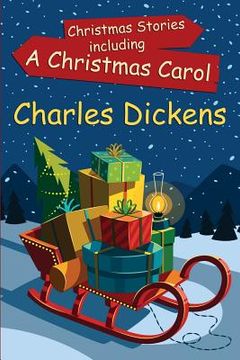
portada Christmas Stories including A Christmas Carol: (Starbooks Classics Editions)
Type
Physical Book
Publisher
Language
English
Pages
132
Format
Paperback
Dimensions
22.9x15.2x0.8 cm
Weight
0.20 kg.
ISBN13
9781500629014

Christmas Stories including A Christmas Carol: (Starbooks Classics Editions)

Charles Dickens (Author) · Createspace · Paperback

Christmas Stories including A Christmas Carol: (Starbooks Classics Editions) - Charles Dickens

New Book Imported to Austria
Delivery: 09 Dec - 16 Dec Shipping: 17 to 21 business days.
22,59 €
Import costs and 10% VAT included in the price ✅
22,59 €

Synopsis "Christmas Stories including A Christmas Carol: (Starbooks Classics Editions)"

Christmas Stories including A Christmas Carol by Charles Dickens Contents A CHRISTMAS CAROL Some Christmas Stories A CHRISTMAS TREE WHAT CHRISTMAS IS AS WE GROW OLDER THE POOR RELATION'S STORY THE CHILD'S STORY THE SCHOOLBOY'S STORY NOBODY'S STORY "It is a fair, even-handed, noble adjustment of things, that while there is infection in disease and sorrow, there is nothing in the world so irresistibly contagious as laughter and good humour." --- Charles Dickens, A Christmas Carol A Christmas Carol is a novella by English author Charles Dickens, first published by Chapman & Hall on 19 December 1843. It tells the story of bitter old miser Ebenezer Scrooge and his transformation resulting from supernatural visits by Jacob Marley and the Ghosts of Christmases Past, Present and Yet to Come. The novella met with instant success and critical acclaim. The book was written and published in early Victorian era Britain, a period when there was strong nostalgia for old Christmas traditions together with the introduction of new customs, such as Christmas trees and greeting cards. Dickens' sources for the tale appear to be many and varied, but are, principally, the humiliating experiences of his childhood, his sympathy for the poor, and various Christmas stories and fairy tales. The tale has been viewed by critics as an indictment of 19th century industrial capitalism. It has been credited with restoring the Christmas season as one of merriment and festivity in Britain and America after a period of sobriety and sombreness. A Christmas Carol remains popular - having never been out of print - and has been adapted many times to film, stage, opera, and other media. In the mid-19th century, a nostalgic interest in former Christmas traditions swept Victorian England following the publication of three influential books: Davies Gilbert's Some Ancient Christmas Carols (1822), William Sandys's Selection of Christmas Carols, Ancient and Modern (1833), and Thomas K. Hervey's The Book of Christmas (1837). That interest was further stimulated by Prince Albert, Queen Victoria's German-born husband, who popularised the German Christmas tree in Britain after their marriage in 1841, the first Christmas card in 1843, and a revival in carol singing. Hervey's study of Christmas customs attributed their passing to regrettable social change and the urbanisation of England. Dickens' Carol was one of the greatest influences in rejuvenating the old Christmas traditions of England but, while it brings to the reader images of light, joy, warmth and life, it also brings strong and unforgettable images of darkness, despair, coldness, sadness and death. Scrooge himself is the embodiment of winter, and, just as winter is followed by spring and the renewal of life, so too is Scrooge's cold, pinched heart restored to the innocent goodwill he had known in his childhood and youth.
Charles Dickens
  (Author)
View Author's Page
Charles Dickens (February 7, 1812 - June 9, 1870) was born in Portsmouth and was the eldest son of a Royal Navy clerk. At twelve, his father's imprisonment for debt forced him to work in a blacking factory. His education was sporadic: he taught himself shorthand, worked as a clerk in a law office, and eventually became a parliamentary correspondent for the Morning Chronicle.

Coming from a humble family, "good old Charles" did not receive formal education until he was nine, and was heavily criticized by the critics of the time for being too self-taught. His life took an unexpected turn with his father's imprisonment for debts, moving his family to live with him in jail, allowed at that time by British laws. At the age of 12, he was already considered fit to start working in a dye factory. Although his family's situation had improved, his mother insisted he keep working there, inspiring him to write one of his masterpieces, David Copperfield.

His articles, later collected in Scenes from London Life by "Boz" (1836-1837), were very successful, and with the appearance in 1837 of The Posthumous Papers of the Pickwick Club, Dickens became a true publishing phenomenon. Novels such as Oliver Twist (1837-1839), Nicholas Nickleby (1838-1839), and Barnaby Rudge (1841) gained enormous popularity, as did some travel chronicles, such as Pictures from Italy (1846). With Dombey and Son (1846-1848) he began his mature period, of which good examples are David Copperfield (1849-1850), his first novel in the first person and his favorite, in which he developed some autobiographical episodes; Bleak House (1852-1853); Little Dorrit (1855-1857), A Tale of Two Cities (1859), Great Expectations (1860-1861), and Our Mutual Friend (1864-1865). He died at Gad's Hill, his country house in Higham, in the county of Kent.
See more
See less


Customers reviews

Frequently Asked Questions about the Book

All books in our catalog are Original.
The book is written in English.
The binding of this edition is Paperback.

Questions and Answers about the Book

Do you have a question about the book? Login to be able to add your own question.

Opinions about Bookdelivery

More customer reviews